Get back in practice
Like riding
a bike.
You used to be fine at this. A few short goes and most of it comes back.
Free to start. No card.
Set up. Talk. Get scored.
Four surfaces and one journey: pick a scene, hold the disc and speak, then read the score and what to do about it.
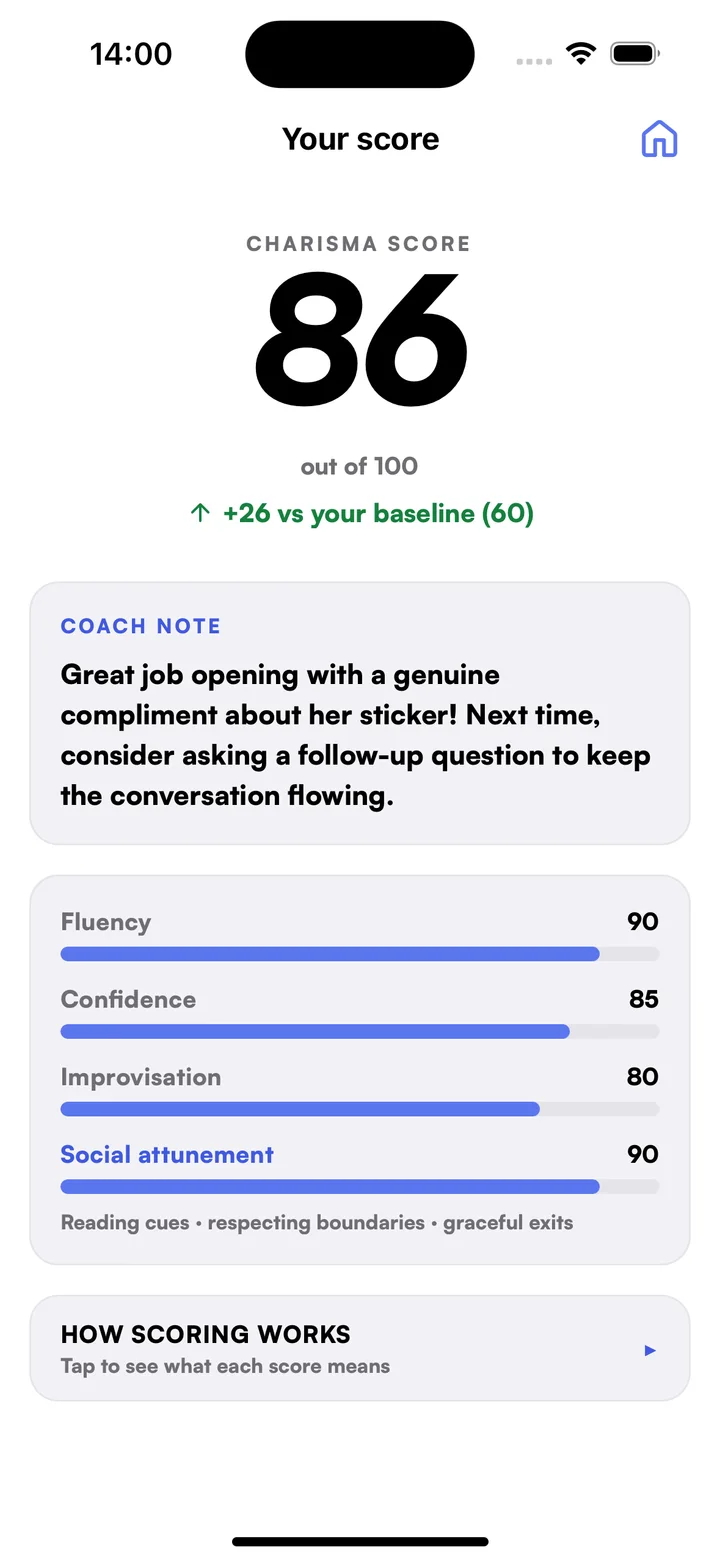
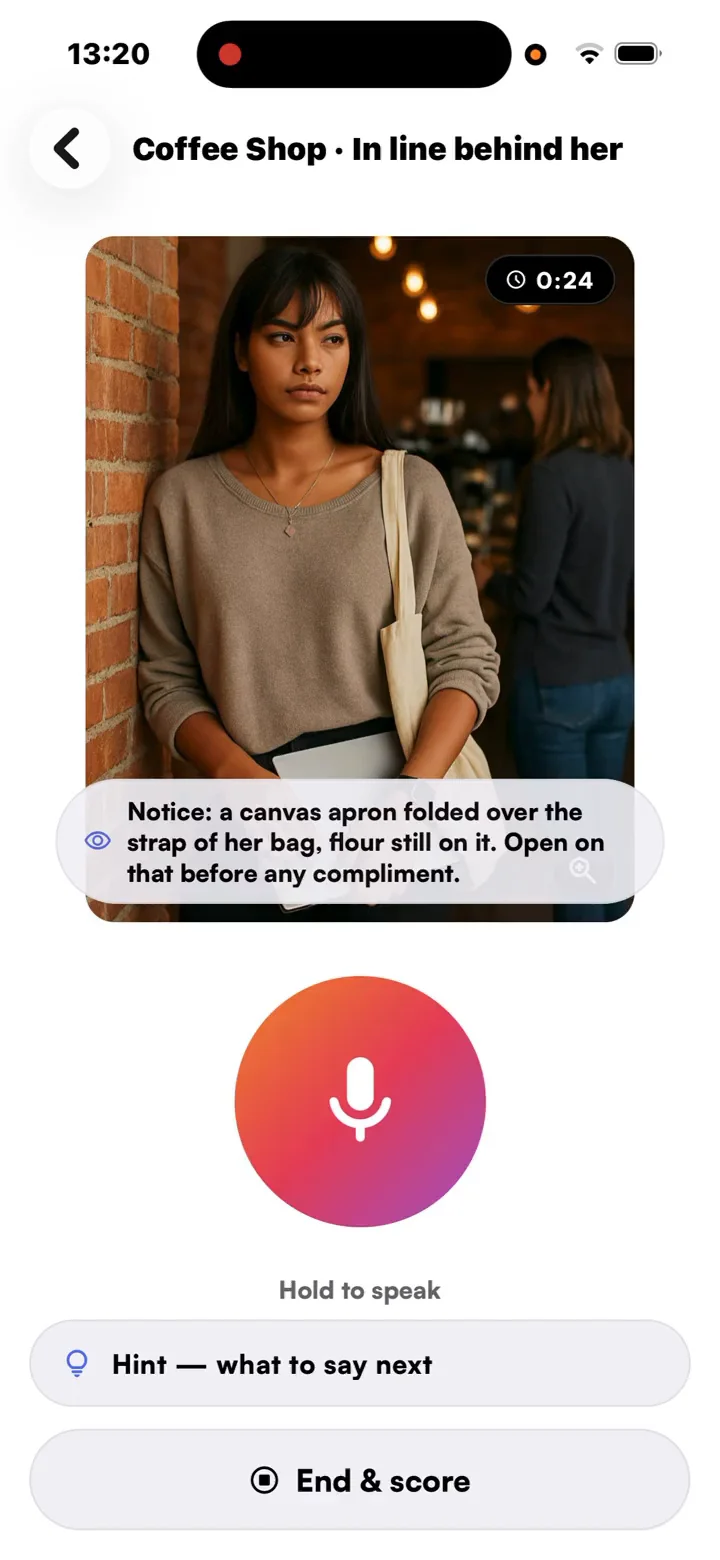
Live session, then the score — the portrait is the content and the disc the only control; the number stands on the page, and delivery is measured from the voice. 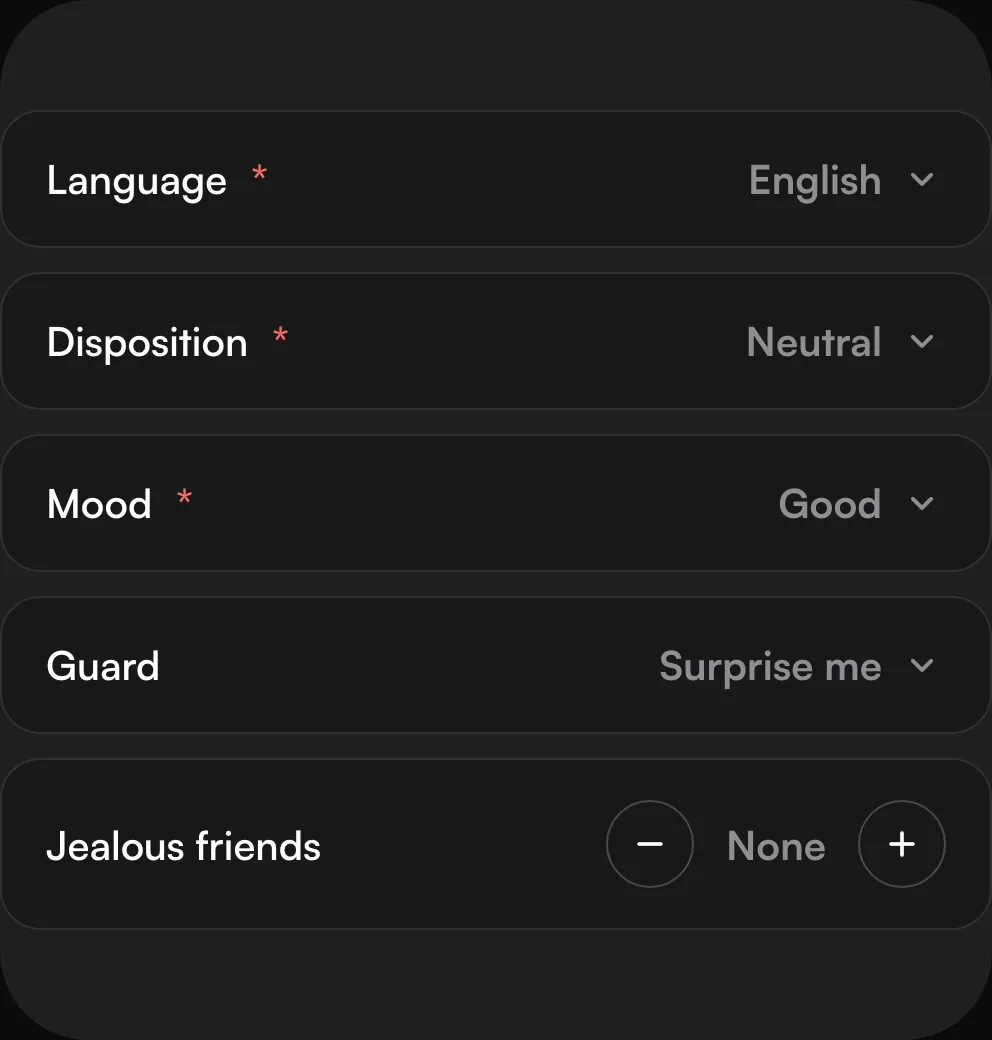
Setup — one line per setting, a red mark on what is required. 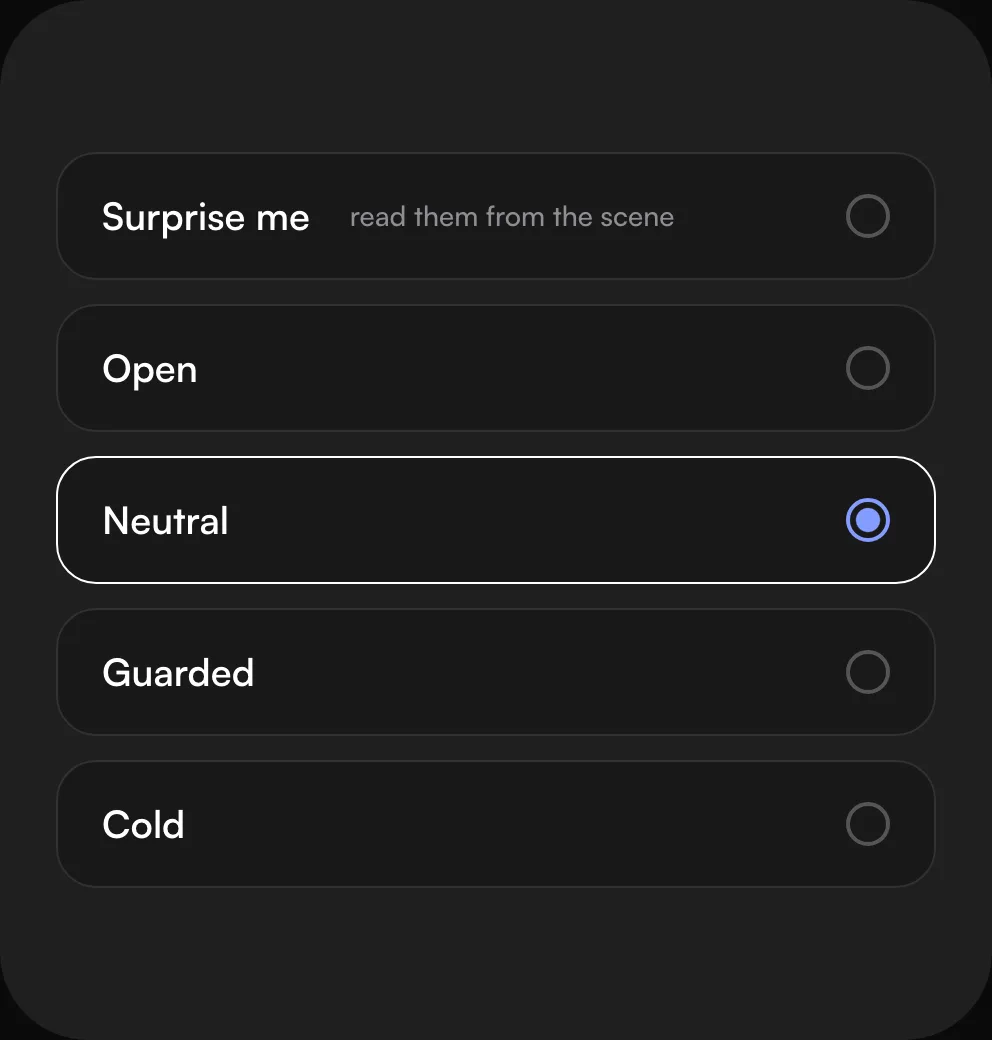
Disposition — one list, the chosen row outlined. - Recommended
Max
Everything, without a limit
- Everything in Pro
- Real Talk — analyze recordings & chat screenshots, Get Advice
- Custom Practice — build any person you describe
- Unlimited conversations
- The most capable voice model
Plans — Max first, and recommended. 
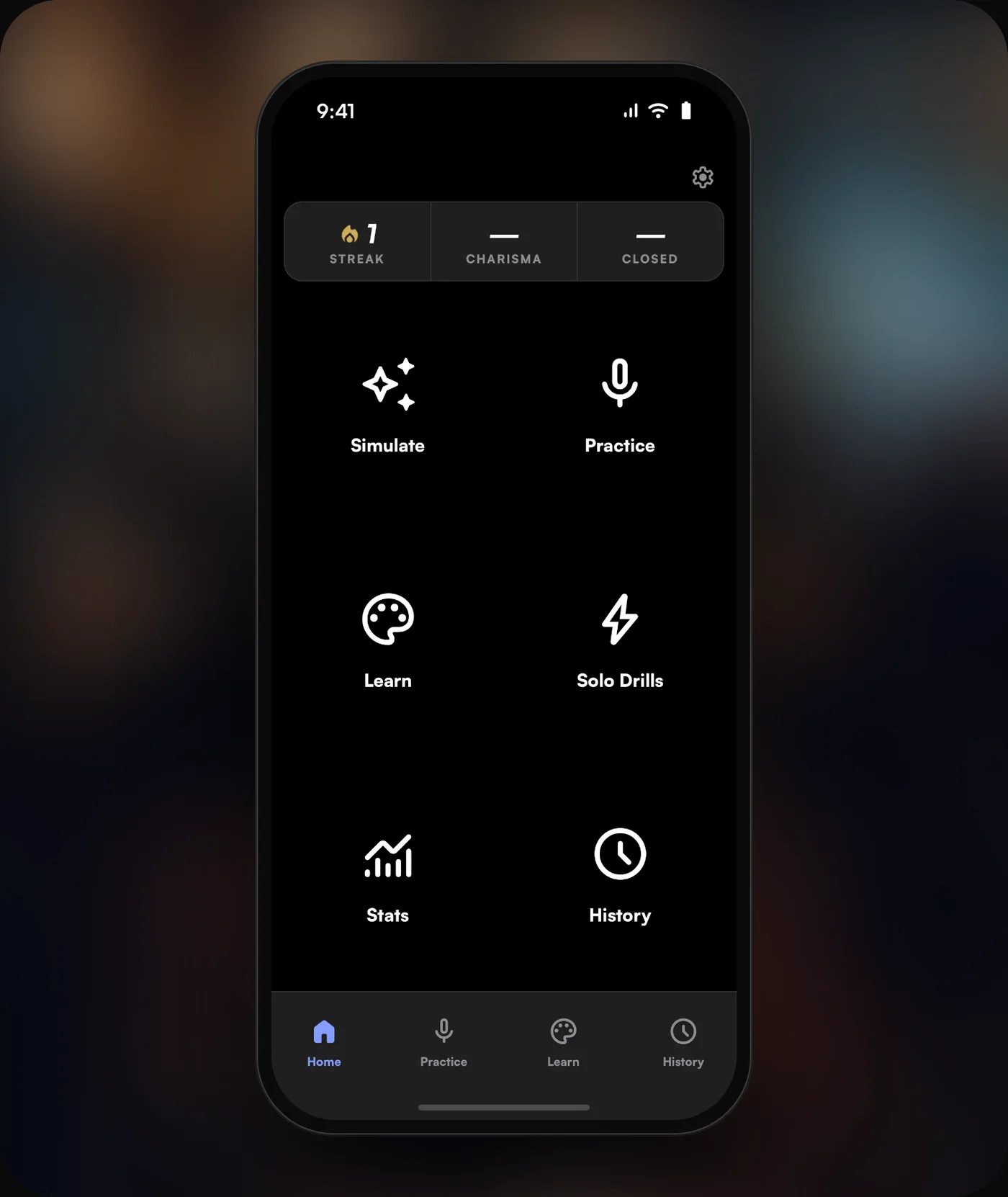
Four surfaces — Home, Practice, Learn, History. 
On the home screen, next to everything else.
It comes back quickly.
You have done this before. It needs using, not fixing.
Start small. A few minutes. Warm up first. Watch it come back.
Start small
Your phone, your room. Nobody to explain yourself to afterwards.
A few minutes
Three minutes a day beats one hard night out.
Warm up first
Two goes before you head out, so the first real chat is not the cold one.
Watch it come back
Same score every time, so you can see it move instead of guessing.
It went quiet.
Nothing changed about you. You just stopped getting the practice.
- 01
The circle got smaller
A move, a break-up, working from home. Fewer chats, without choosing it.
- 02
So it takes effort
The thing that used to be automatic now needs thinking about.
- 03
And you notice
Which is the bit that makes it feel awkward.
Three minutes.
Pick a place
A café, a gym, a party.
Talk
Hold the button and speak. She answers straight away.
See your score
What worked, what did not, and what to say instead.
Pick somewhere to walk into
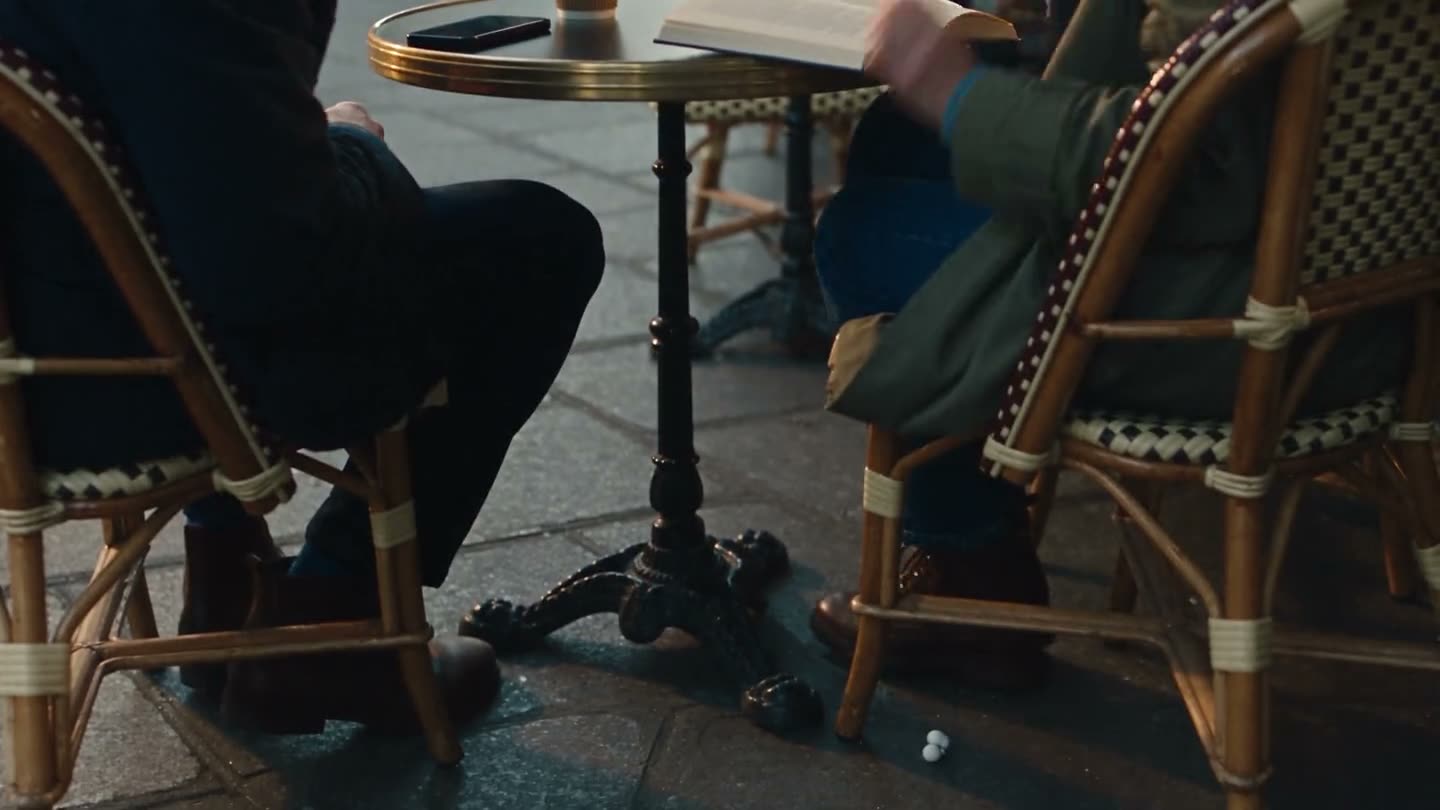
The queue. Thirty seconds of shared waiting, and an opening if you take it.
1 of 4 · plays the next one automatically
Every room you have been avoiding.
Bars, parties, the park, the gym — then the date, and the moments that go wrong. Every scene answers in voice and is scored.
In the app’s own words: “Real-world locations and settings to practice improvisation, deduction and emotional intelligence to create rapport with a person.”
From Pro
Approach
94 scenes across 14 venues
Opening with someone who did not expect you, reading what her scene card and her dials are telling you, and getting to a number or a plan — or a clean exit.
- Bar
- Beach
- Café
- Coffee Shop
- Gym
- Park
- Festival
- Campus
- Office
- Street
From Pro
Situational Pressure
Stay calm when someone comes at you
5 scenes
Holding your composure when the other person is not calm: de-escalating without backing down, and leaving with the situation smaller than you found it.
- Jealous Boyfriend
- Angry Relative
- Drunk Person
- Police Stop
- Street Hustler
From Max
Date
She said yes. Listen, then close.
6 scenes
The evening after the approach worked. Most of it is listening; the close is the next date, never a phone number.
- First date, coffee
- Dinner
- Drinks after work
- Walk in the park
- Gallery date
- Second date, cocktail bar
From Max
Reverse Role
He’s opening. Hold your frame.
5 scenes
The other side of everything above: he approaches, with his persistence and smoothness on dials, and you are scored on reading him, holding your frame, and saying yes or no cleanly.
- The regular
- The nervous one
- Won’t take the first no
- The shy one
- Friend of a friend
From Pro
Improv and drills
16 scenes
The reflexes under all of it: accepting what you are given, keeping something running, holding your ground without getting louder.
- Yes, And
- Questions Only
- Random Improv
- Status Game
- Rejection Catch
- Tough feedback
Proof it is coming back.
The same score every session, so week six against week one is a number, not a feeling.
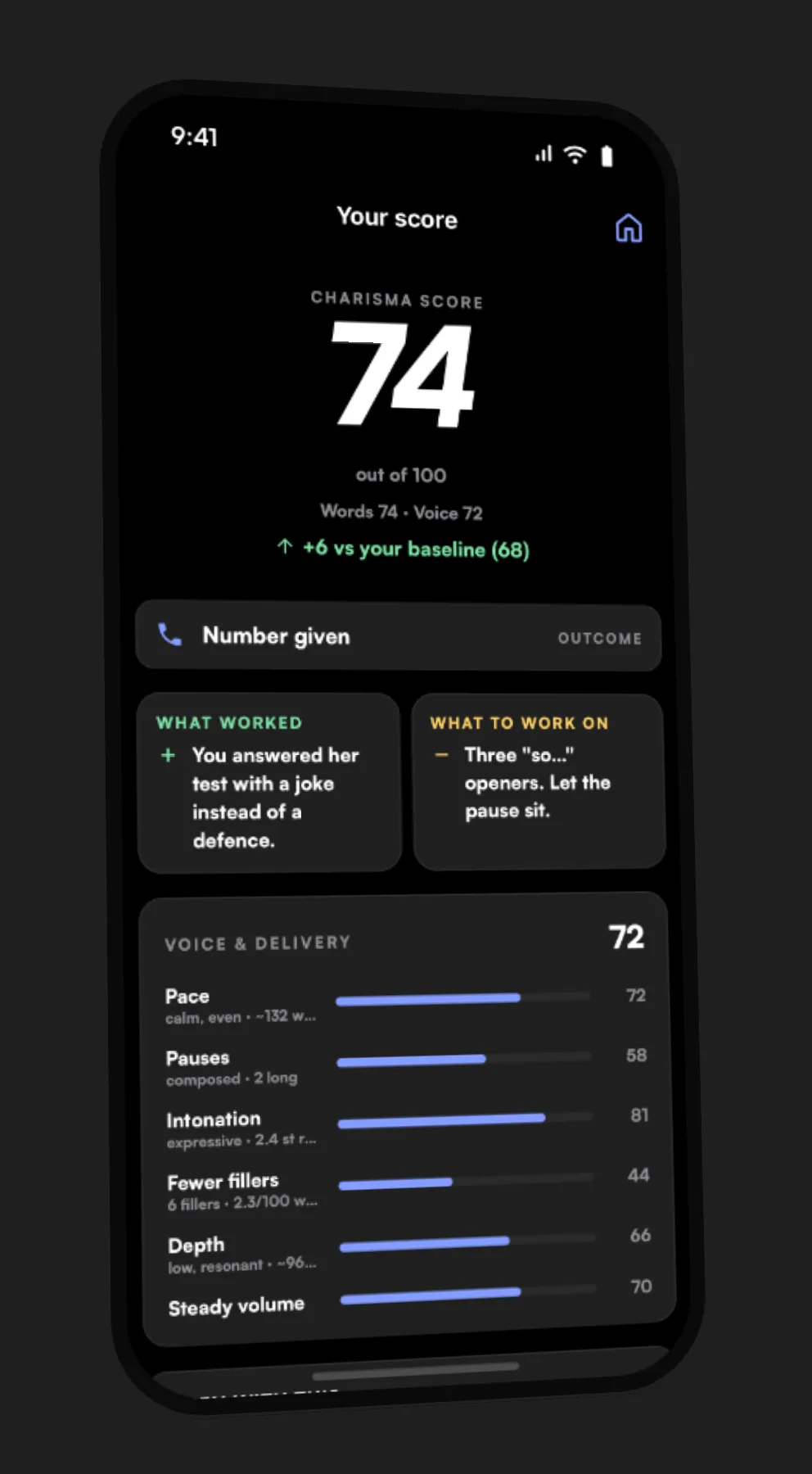
Tap any score
“7 fillers in 3 minutes; pace 142 wpm; target band 130–160.”
Last 14 sessions
Six weeks and the line moves.
The one from last night, rated rather than guessed.
Describe it or upload it and see how it actually went. Then, before the next one, the openers for the place you are already in.
Upload an Audio FilePros, cons, improvements + a grade on a conversation you actually had.
- A Charisma grade from 0 to 100, with the working shown
- Voice and delivery: depth, intonation, pace, pauses, fillers, steadiness
- The magic phrases you used, and the ones you missed
- The full transcript, turn by turn
- WAV, MP3, M4A, AAC, FLAC, OGG, OPUS, MP4, MPEG or WEBM — up to 25 MB, about five minutes — in English, Spanish or Russian
Generate & Rate ConversationDescribe it, dictate it, or add chat screenshots — the coach reads it in the language it was written in, summarizes it and rates how you communicated.
- What happened, reconstructed from your summary or read straight off the screenshots
- What worked, what to fix, and what to do next time
- How it ended — a number, socials, a plan, an open door, a soft no or a hard no
- Add what you think went wrong, and it tells you whether you are right
Get AdviceDescribe where you are and who she seems to be — get 2–3 openers, where to take it, and what to avoid, tuned to your history.
- The read: what the situation is actually telling you
- Two or three openers, best first, each with why it fits
- Where to take it, with each direction marked high or medium likelihood and a signal to watch for
- What to avoid, and what to do if it stalls
- Then practise exactly that, live
Real Talk is part of the Max plan. Recordings and rated conversations are saved to History and count toward your real stats.
Plenty to talk about again.
The techniques, and enough material that nothing has to be forced.
- 128
- live scenarios
- 104
- techniques to learn
- 2,766
- things to talk about
- 3
- languages
104 techniques, one at a time
Distilled from 13 sources on conversation, rapport, humour and reading a room. You get the core of a shelf of books without reading the shelf, and each one arrives in the scene where you would actually use it.
Art, music, film, places, people
Paintings and sculpture, songs and genres, films and the scenes worth quoting, world attractions, gestures, symbols, what jobs are really like. Enough to have something to say when the conversation turns to any of it.
Read the room, on purpose
Deduction, gestures, accents, insider terms, what different countries do differently. The observation half of a conversation, which is the half nobody teaches.
- Charisma training26
- Countries195
- Accents in English29
- Famous movies380
- Songs263
- Tattoos372
- World attractions204
- Bizarre country facts197
- Famous paintings195
- Amulets & pendants146
- People worth knowing139
- Sculptures71
- Palm reading67
- Professions & jokes56
- Music genres55
- Insider terms50
- Relationship terms45
- Gestures38
- The art of deduction24
- Screen romance23
- Coffee cup reading21
- Horoscope20
Before you ask.
Do I have to talk out loud?
Yes. You hold a button and speak, and she speaks back. There is no typing.
How long until it feels normal?
Most of it is warming up, not learning. The score works the same way every time, so you can watch the trend instead of guessing.
Is it just a guess?
No. Your speed, pauses and filler words are measured from the recording. Tap any score to see the numbers.
What happens to my recordings?
Your voice is used to score the session and nothing else. Transcripts and scores stay until you delete them, and deleting your account removes them. No contacts, photos or location. No ads.
What does it cost?
Free to start, three conversations a week. Pro is $25 a week or $69 a month; Max is $49 a week or $129 a month. Cancelled from the App Store.
How do I get it?
It is on TestFlight for iPhone. Tap Get early access and it takes you there.
How to actually do it
Openers, what to notice, and how long you have.
The excuse, or straight in: two ways to open
Every opener is one of two things. Knowing which one you are doing is most of the job.
Break the ice: say hello in their language
It costs you one word and it almost always works. It can also go wrong in exactly two ways.
Notice one thing: the observation opener
The opener people remember is not clever. It is specific, and it is about something they chose.
Or start with the method in four moves.
Before it counts
Practise the conversation before you have it.
Free to start. No card. Three conversations a week, and nobody hears you.